
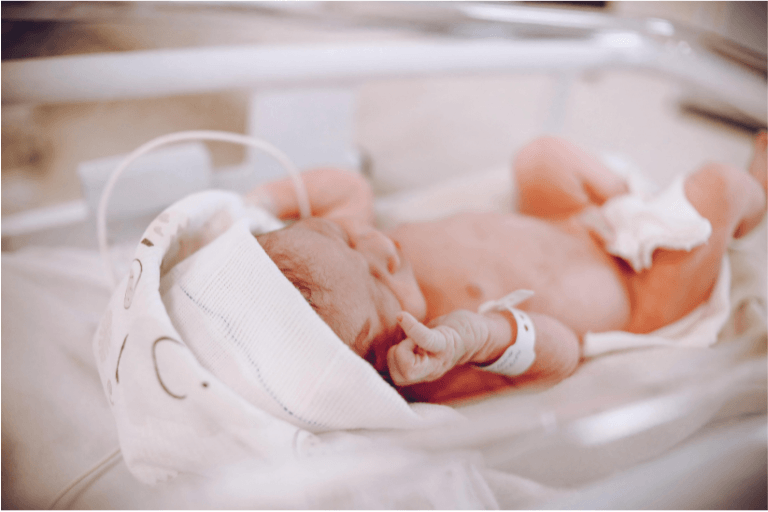
If your newborn’s skin or eyes look slightly yellow in the first few days of life, you’re not alone; it happens to roughly 3 in 5 full-term babies, and even more premature babies. In most cases, it’s harmless and goes away on its own. But because in rare cases high bilirubin levels can affect a baby’s brain, it’s worth knowing exactly what’s normal, what’s not, and when to call your pediatrician.
Quick answer: Mild jaundice usually appears on day 2–4 of life, peaks around day 5, and clears up by 1–2 weeks; this is normal and needs no treatment beyond monitoring. Call your pediatrician the same day if jaundice appears within the first 24 hours of life, spreads to your baby’s arms, legs, or the whites of their eyes, or your baby is feeding poorly, unusually sleepy, or hard to wake.
What Causes Newborn Jaundice?
Jaundice happens when a yellow pigment called bilirubin builds up in your baby’s blood faster than their liver can clear it. Bilirubin is a normal byproduct of red blood cells breaking down; every baby makes it. The difference is that a newborn’s liver is still immature in the first days of life, so it processes bilirubin more slowly than an adult’s liver does.
Physiological (Normal) Jaundice vs. Pathological Jaundice
Physiological jaundice is the common, harmless type:
- Appears around day 2–4 of life
- Peaks around day 5
- Clears up on its own within 1–2 weeks
- Doesn’t need treatment beyond routine monitoring
Pathological jaundice is less common and needs medical attention:
- Appears within the first 24 hours of life
- Rises very quickly or reaches high levels
- Lasts longer than 2–3 weeks
- Is caused by an underlying issue — such as a blood type mismatch with the mother, an infection, or a liver problem
Signs and Symptoms to Watch For
Jaundice typically starts on the face, then moves down to the chest, tummy, and finally the arms and legs as it becomes more pronounced. It’s harder to see in babies with darker skin tones; checking the gums, inner lips, and the whites of the eyes can help.
A simple home check: gently press a finger on your baby’s forehead or nose, then lift it. If the skin looks yellow where you pressed, that’s a sign of jaundice.
When to Call Your Pediatrician Right Away
Contact your baby’s doctor the same day if you notice:
- Jaundice appearing in the first 24 hours of life
- Yellowing spreading to the tummy, arms, or legs
- Your baby is unusually sleepy or hard to wake
- Poor feeding or fewer wet/dirty diapers than usual
- High-pitched or unusual crying
- Your baby seems floppy or limp
- Jaundice that is getting worse rather than better after day 5
- Jaundice that hasn’t resolved by 2–3 weeks of age
Who Is More Likely to Get Jaundice That Needs Treatment?
- Premature babies (born before 37 weeks)
- Babies with a blood type different from their mother’s
- Babies who had a sibling treated for jaundice
- Babies who aren’t feeding well in the first few days
- Babies of East Asian or Mediterranean descent (higher genetic risk factors)
According to Nemours KidsHealth, all newborns should be checked for jaundice before leaving the hospital and again at their first pediatric visit, typically within 3–5 days of birth.
How Is Jaundice Treated?
Most babies need no treatment at all, just monitoring and frequent feeding, which helps the body clear bilirubin faster. If levels are high enough to need treatment, options include:
- Phototherapy — special blue light that helps break down bilirubin so it can be excreted (the most common treatment)
- Increased feeding frequency — to encourage bilirubin to pass out through bowel movements
- Rarely, an exchange transfusion — for very high bilirubin levels that don’t respond to other treatment
Breastfeeding and Jaundice
Breastfeeding doesn’t cause jaundice, but two related patterns can occur:
- Breastfeeding jaundice — happens when a baby isn’t yet feeding often or effectively enough in the first few days, so bilirubin isn’t cleared as quickly. The fix is usually more frequent, well-supported feeding, not stopping breastfeeding.
- Breast milk jaundice — a longer-lasting, usually harmless type linked to substances in breast milk, that can persist for several weeks in an otherwise healthy, well-feeding baby
Related Reading
- Tips for Caring for Your Newborn After Birth
- Newborn Care Essentials: Breastfeeding Basics
- Signs of Dehydration in Infants
- Newborn First Visit With Pediatrician in Dubai
- The Role of a Neonatologist in Neonatal Care
Frequently Asked Questions
Is jaundice in newborns normal?
Yes, mild jaundice is very common, affecting around 60% of full-term babies and up to 80% of premature babies. Most cases are harmless and resolve on their own within one to two weeks.
How can I tell if my baby’s jaundice is getting worse?
Watch for yellowing spreading from the face down to the chest, tummy, arms, or legs, along with poor feeding, unusual sleepiness, or a weak cry; these signal it’s time to call your pediatrician.
Can breastfeeding cause jaundice?
Breastfeeding itself doesn’t cause jaundice, but if a baby isn’t feeding frequently enough in the first days, bilirubin can build up more than usual. More frequent, well-supported feeding usually resolves this.
When does newborn jaundice go away?
Physiological (normal) jaundice typically peaks around day 5 and clears up within 1–2 weeks. If it lasts longer than 2–3 weeks, tell your pediatrician.
Noticed yellowing in your newborn’s skin or eyes? Book an appointment with Dr. Olfa Koobar for a prompt evaluation.